
KDE Gear ⚙️ 26.08
“Enjoy Shiny Stuff” edition
Jeudi, 20 Août 2026
Another four months of development and we are back with a brand new batch of apps. In KDE Gear 26.08, you’ll find updates, new features, and great tools to run and enjoy your digital life.
Today we will be examining some of the more interesting changes landing in KDE’s most popular apps.
Let’s get started!
Support KDE! Become a Supporting Member: you can contribute to keeping our projects alive, get your name into our Hall of Fame, and even Adopt an App!
Okular
Okular is KDE’s flagship document reader most commonly used for reading, signing, and annotating PDFs while also being an excellent eBook and comic reader that can also render Markdown.
In this new version, we have reinforced the signing features resulting in the process becoming more secure and streamlined. We have also melded both settings dialogs (Configure Backends and Configure Okular) into one, making everything less confusing.
More visible features include changes to the text selection: a triple click now selects a whole line, and annotations: Okular will automatically include any highlighted or underlined text in an associated note. You can also copy and paste some of your annotations (notes and inline comments) within the same document or onto another.
Dolphin
Dolphin is KDE’s powerful file/folder/server explorer. Version 26.08 goes even further and improves its integration with KDE Connect. When exploring files on your phone from Dolphin, click on the Open KDE Connect button at the top of the window to make the KDE Connect app appear.
If you are browsing a busy directory, open the Filter Bar with Ctrl + i to use plain text, globbing (like you would use with the ls command in the terminal), or Regular Expressions to sort through the files.
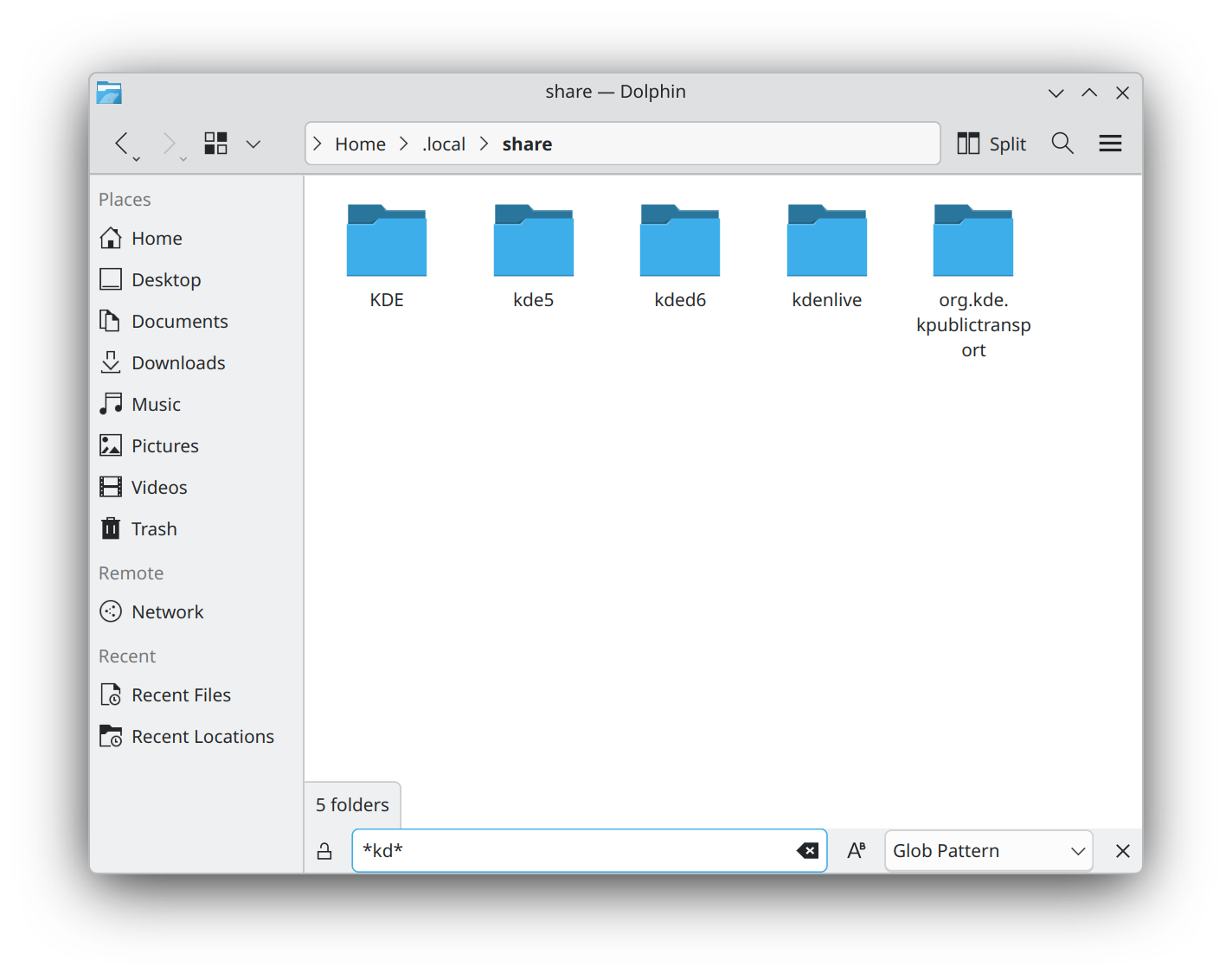
In a similar vein, you can now group files and folders independently from the sorting criterion. This means you can order files alphabetically by name and then group the files by type.
And if the number of tabs you have open gets out of hand, right click on a tab and you can chose to close the tabs to the right, left, or both.
Konsole
Konsole is KDE’s terminal emulator and comes with many features and utilities.
You can now hold down the Alt key, click on an underlined file name, and drag it somewhere else. Also, drag an image onto an image editor to open “Ready for Editing”, drag it onto a text editor and it will copy the path to the file.
The same can now be done with links, email addresses, and color terms too. Drag a link to an empty tab in your browser and it will open the page the link points to. Move the link onto a text editor, and it will download the HTML of the page ready for editing. Drag a color code onto an image in Krita and it will flood the layer with that color. Or drag the same color code onto a text editor and the color’s hexadecimal code will be typed out for you.
Kdenlive
Kdenlive is KDE’s feature-rich video editor. 26.08 comes with lots of quality of life improvements and polishing.
In the effects department for example, you can now move the Transform effect’s rotation axis wherever you want, instead of having it fixed to the center of the item you need to rotate.
The Gradient Map effect now lets you add multiple stops to a gradient, and you can now adjust the curves in the Curves (avfilter) effect independently to the get the color hues you need.
Down on the timeline, you can copy a selection to a new sequence, or have Kdenlive create audio tracks automatically as needed for your clips. You can also reorder tracks and configure different colors for each item type — video, image, title, etc.

In the Titler, you can now copy and paste objects, give rectangles rounded corners, and snap objects to the center and edges of the screen as well as to other items. This feature includes a visual guide to help you.
Minuet
Minuet is KDE’s application for music education. It helps students and musicians train their ears with exercises for intervals, chords, scales, and rhythms.
Minuet has a new interface built to work well on both desktop and mobile screens. The home page and navigation drawer make exercise categories easier to find while making the exercise browser present each activity as a card with a short description. Your current category remains highlighted, and the new search field filters exercises by their translated names and descriptions. Exercise pages have also been reorganized to use the available space better on narrow windows and phones.
Note complète de version ici
Où obtenir des applications de KDE
Bien que toutes les distributions fournissant nos logiciels soient totalement prises en charge, les applications pour KDE Gear 26.08 seront également disponibles sous peu sur ces magasins d'applications pour Linux :
Si vous souhaitez contribuer à l'introduction de plus d'applications dans les boutiques d'applications, à la prise en charge de plus de magasins d'applications et à une meilleure intégration des applications dans notre processus de développement, n'hésitez pas à venir nous saluer dans notre salon de discussions concernant toutes les applications (À propos).
Veuillez noter que les paquets de cette version pourraient ne pas être disponibles pour toutes les distributions au moment de cette annonce. Page de wiki pour le téléchargement de paquets
Compilation de KDE Gear
Le code source complet de KDE Gear 26.08.0 peut être librement téléchargé. Les instructions pour sa compilation et son installation sont disponibles à partir de la page d'informations de KDE Gear 26.08.0.
À propos de KDE
KDE est une équipe technologique internationale créant des logiciels « Open source » et libres pour les ordinateurs de bureau et les ordinateurs portables. Parmi les produits de KDE, il y a un système de bureau moderne pour les plates-formes Linux et UNIX, des suites complètes de logiciels de groupe de travail et de productivité et des centaines de titres de logiciels dans de nombreuses catégories, y compris Internet et applications Internet, multimédia, loisirs, éducation, graphisme et développement de logiciels. Les logiciels de KDE sont traduits dans plus de 60 langues. Ils sont conçus pour être faciles d'utilisation et avec des principes d'accessibilité modernes. Les applications de KDE incluant de nombreuses fonctionnalités s'exécutent en mode natif sur Linux, BSD, Windows, Haiku et macOS.
Avis pour les marques déposées.
Les logos de KDE® et l'environnement de bureau « K »® sont des marques déposées de KDE e.V.
Linux est une marque déposée de Linus Torvalds. UNIX est une marque déposée de « Open Group » aux États unis et dans d'autres pays.
Toutes les autres marques déposées et licences référencées dans cette annonce sont la propriété de leurs propriétaire respectifs.
Contact de presse
Pour plus d'informations, veuillez nous contacter par courriel : press@kde.org